Curriculum » Curriculum (All subjects) » English » Writing at IWPS Years 1-6
Writing LTP Attached you will find the Long Term Plan for Writing at Ireland Wood Primary School. Most of our focus areas in writing are planned as part of our immersive curriculum but our plan is a working document and is adapted to incorporate national events and celebrations. We aim to provide a broad and balanced curriculum for the children at our school which ensures a wide range of genres are taught.
Writing
At Ireland Wood, we believe that every child should have the opportunity to become an independent, confident and capable writer. Writing is taught through a clear, progressive framework, with a strong emphasis on securing foundational knowledge, including transcription (spelling and handwriting) and composition (sentence structure and organisation).
Children develop their ability to express ideas and communicate effectively through the written word. Through modelling, shared writing and guided practice, pupils are supported to apply their knowledge with increasing independence. We ensure that children develop a strong command of English through accurate use of punctuation, spelling and grammar.
Opportunities are planned for pupils to write for a range of purposes and audiences, applying their skills in meaningful contexts. The link between reading and writing is strongly emphasised, using high-quality texts to develop vocabulary, grammatical understanding and awareness of how writers craft their work.
Reception
In Reception, high-quality texts are used to inspire early writing within a structured writing framework. The focus is on securing the foundational skills of transcription, ensuring children develop confidence in letter formation, spelling and applying their phonic knowledge.
Children are taught to form letters correctly, link sounds to graphemes and write words by segmenting sounds (e.g. using ‘Fred Fingers’). As their confidence grows, they begin to record simple sentences, with the emphasis remaining on accurate transcription rather than extended composition.
Writing is embedded across all areas of provision, with opportunities for purposeful mark-making and early writing both indoors and outdoors. Children are encouraged to write independently in meaningful contexts, applying their phonics knowledge as they develop the foundations needed for later writing.
The Four C's Approach: Connect, Collect, Construct, Create
We aim for our writing curriculum to be an exciting and engaging experience. The Four C's Approach, 'Connect, Collect, Construct and Create,' is the sequence in which writing follows in years 1-6. All of our writing is highly immersive and links to the current topic being studied by the children in class. We base our writing approach on Jane Considine's 'The Write Stuff'.
Narrative
When teaching narrative, the teacher chooses a text/stimulus that is broken down into 'Plot Points'. One plot point = one lesson. The children are closely guided through the writing process by the teacher. Each writing lesson is made up of 'learning chunks' (2 learning chunks in Year 1, 3 learning chunks in Year 2-6). Within each learning chunk, the children will connect, collect and construct. Each learning chunk has a specific focus e.g. expanded noun phrases.
Non-Fiction
When teaching non-fiction, the children learn the features and layout of the text they will be writing e.g. instructions. The features of the text are organised into 'shapes' for the children to remember. These 'shapes' form the structure of each lesson (like 'plot points' in narrative). Each writing lesson is made up of 2 or 3 'learning chunks'. Within each learning chunk, the children will connect, collect and construct. Each learning chunk has a specific focus e.g. alliteration.
Components of Writing
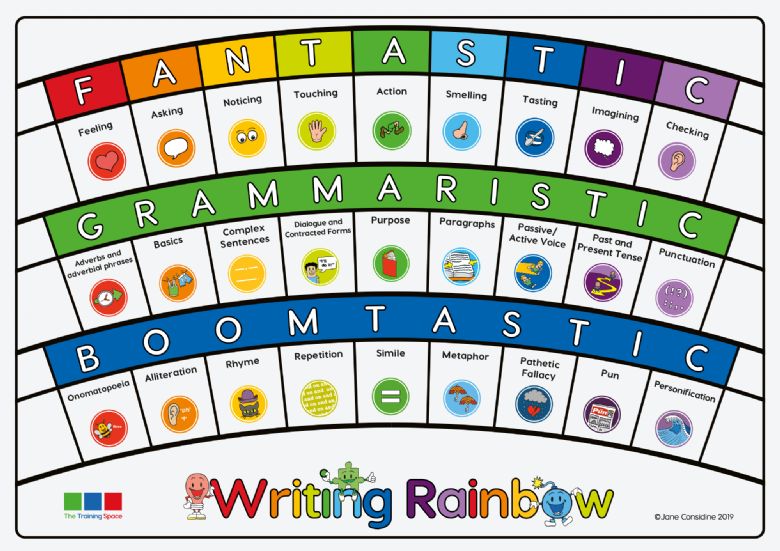
We use Jane Considine's three essential components to support children in becoming great writers. The FANTASTICs (Ideas), The GRAMMARISTICs (Tools), and The BOOMTASTICs (Techniques) support their learning, precision and writing. We call each individual component a writing 'lens'.
- The FANTASTICs system allows children to identify the nine elements that all text types are comprised of. When pupils are familiar with these nine elements, they are able to ensure that they are incorporated into their writing. The FANTASTICs help children to sharpen their understanding of their own and others’ writing by encouraging them to be observant and reflective.
- The 9 GRAMMARISTICs cover national curriculum requirements, capturing the broad spectrum of key grammar knowledge. Discrete gammar lessons are also taught to ensure specific grammar knowledge is taught and revisited. A grammar routeway is used to ensure consistency and progression through school.
- The BOOMTASTICs capture the ten powerful ways to add drama and poetic devices to writing. They help children structure their work, teaching them to showcase their writing voice, demonstrate originality and to take risks in a bid to capture the truth of a situation.
Connect, Collect, Construct
Connect: Children need ideas to enable them to write. Within the 'Connect' stage, the children engage with the writing stimulus and generate vocabulary/ideas that can be used in their sentences. Throughout the whole process, the children also take part in 'Connect Experience Lessons'. These might include: drama activities, music, trips/visitors, art etc.
Collect: During the ‘Collect’ stage, the teacher shares examples of high-quality words/phrases that are ambitious that the children can 'chot' (chat and jot) down. These words/phrases are linked to one of the writing lenses (from the Components of Writing). The children have an opportunity to 'chot' their own ideas down at this stage. Through 'kind calling out', the teacher collects a range of words/phrases from the children and scribes them on the whiteboard. Children keep their pencils in their hands and jot down any of the words/phrases they want to magpie.
Construct: Using the scribed list of shared ideas, the teacher now models writing a sentence live with the children. This modelled sentence demonstrates the writing techniques and features being taught. The children then use the teachers model to create their own sentence, choosing from their own word/phrase lists.
Deepen the Moment
Within each lesson, the children have opportunities to 'Deepen the Moment'. This means that they can add deeper layers to their sentences or add additional sentences within the same plot point (narrative) or shape (non-fiction). They can use the Fantastic, Grammaristic and Boomtastic lenses to add more information/detail to their writing and show off their own creative writing.
Create - Independent Writing
Create: During the ‘Create’ stage, the children plan, draft, compose and edit their own writing. Throughout the year, time is given for children to publish some of their work, ready for it to be showcased in classrooms or on school writing displays. We want all of our children to feel proud of their writing, therefore we place strong emphasis on providing opportunity for the children to publish and share their work with others.
The children at Ireland Wood love to write because; it allows them to be creative, they can express themselves, they can develop work they are proud of. See what the children have written themselves...